
Types of Pharmaceutical Waste and How to Dispose of Them

Quick Summary: Pharmaceutical Waste Types & Disposal
Waste Category | Container Color | Key Examples | Primary Disposal Route |
Hazardous (RCRA) | Black | Nicotine (P075), Warfarin >0.3% (P001), Chemically toxic/ignitable items | Licensed hazardous waste transporter to EPA-permitted TSDF |
Non-Hazardous | Blue / White | Antibiotics, Statins, Antihistamines, OTC drugs | Licensed medical waste vendor / Incineration |
Controlled Substances | Secured / Rx | Opioids (Oxycodone, Fentanyl), Morphine | DEA-registered reverse distributor / Witnessed destruction |
Trace Chemotherapy | Purple | Empty IV bags (<3% drug), used gowns, gloves | High-temperature medical waste incineration |
Sharps Waste | Red / Sharps | Needles, syringes, lancets (with drug residue) | Approved sharps container → Hazardous or RMW stream |
Most people understand that medications need to be taken correctly. Far fewer understand what happens when they are not used at all, or when they expire, or when a dose is prepared but never administered. What is left behind is pharmaceutical waste, and it is one of the most regulated, most mismanaged, and most consequential waste streams in both healthcare and everyday households.
The EPA has identified pharmaceuticals in rivers, lakes, and groundwater across the United States. Trace drug compounds have been detected in drinking water sources in cities from coast to coast. Aquatic ecosystems show evidence of pharmaceutical bioaccumulation affecting reproductive systems in fish and other wildlife. Antibiotic compounds entering waterways contribute to the growth of antimicrobial resistance. And beyond the environmental picture, improperly discarded controlled substances fuel drug diversion, accidental poisonings, and the opioid crisis.
In 2024 alone, one major medical waste company safely incinerated nearly 30,000 tons of pharmaceutical waste before final disposal, preventing active pharmaceutical ingredients from entering waterways. That figure represents only a fraction of what the U.S. healthcare system generates annually, and it does not account for the enormous volume of medications discarded improperly at the household level every day.
Understanding the types of pharmaceutical waste and the correct disposal method for each is not optional knowledge for healthcare facilities. And increasingly, it is important knowledge for individuals too. This guide covers both.
What Is Pharmaceutical Waste?

Pharmaceutical waste is broadly defined as any medication, drug residue, or drug-contaminated material that can no longer be used and must be discarded. In healthcare settings, this includes expired medications, unused doses, partially used vials, contaminated packaging, IV bags with drug residue, spill cleanup materials, and any device or container that held pharmaceutical contents.
In household settings, pharmaceutical waste most commonly takes the form of leftover prescription medications, expired over-the-counter drugs, and unused portions of treatments that were discontinued.
The way pharmaceutical waste must be handled depends entirely on what category it falls into. A statin left over after a prescription change is managed differently from a fentanyl patch, which is managed differently from a chemotherapy agent. Getting this classification right is the foundation of compliant, safe disposal.
The Main Types of Pharmaceutical Waste
1. Hazardous Pharmaceutical Waste (RCRA Hazardous)
The Resource Conservation and Recovery Act (RCRA), administered by the EPA, defines hazardous pharmaceutical waste as any pharmaceutical that meets a federal hazardous waste listing or exhibits one of four hazardous characteristics: ignitability, corrosivity, reactivity, or toxicity.
Within RCRA hazardous pharmaceutical waste, there are two primary sub-categories.
P-Listed Hazardous Pharmaceutical Waste covers acutely toxic pharmaceuticals. These are drugs whose sole active ingredient appears on the EPA's P-list. The key feature of P-listed waste is that even small quantities, referred to as small quantity or acute hazardous waste, are subject to strict management standards. Examples include nicotine (P075), warfarin at concentrations greater than 0.3 percent (P001), and physostigmine (P204). When a P-listed drug is discarded, even the rinsed container must be managed as hazardous waste.
U-Listed Hazardous Pharmaceutical Waste covers non-acute hazardous waste from discarded commercial chemical products. U-listed drugs are those whose sole active ingredient appears on the EPA's U-list. Examples include certain formulations of chlorambucil, cyclophosphamide (when discarded in its commercial chemical form), and lindane (U129). Like P-listed waste, U-listed waste must be managed as hazardous, though the acute toxicity thresholds are less stringent.
Characteristic Hazardous Pharmaceutical Waste covers drugs that are not listed but still exhibit one of the four hazardous characteristics. An ignitable pharmaceutical is one with a flash point below 140 degrees Fahrenheit. Certain pharmaceutical aerosols or alcohol-based preparations may qualify. A toxic pharmaceutical is one that causes toxicity through leaching, measured by the Toxicity Characteristic Leaching Procedure (TCLP). Many heavy-metal-based medications, including certain selenium and chromium compounds used in clinical practice, can fall into this category.
How to Dispose of Hazardous Pharmaceutical Waste: Hazardous pharmaceutical waste must be segregated from all other waste streams and collected in properly labeled black containers, the standard color coding for RCRA hazardous pharmaceutical waste. It must be transported using a uniform hazardous waste manifest by a licensed hazardous waste transporter and disposed of at an EPA-permitted treatment, storage, and disposal facility (TSDF). Healthcare facilities are prohibited from disposing of hazardous pharmaceutical waste in the sanitary sewer, in solid waste containers, or by any other means that bypasses permitted disposal.
2. Non-Hazardous Pharmaceutical Waste
Non-hazardous pharmaceutical waste includes drugs that do not meet the criteria for RCRA hazardous classification but still require proper disposal to prevent misuse, diversion, or environmental contamination. This category covers most common prescription medications, over-the-counter drugs, vitamins, and nutritional supplements.
Examples include most antibiotics, antihypertensives, statins, proton pump inhibitors, antihistamines, and other common therapeutic agents that are not listed under RCRA and do not exhibit hazardous characteristics.
Although this waste is not regulated under RCRA as hazardous, it is still subject to EPA and state-level regulations that prohibit disposal in the regular trash or sanitary sewer for many facility types. It is not a category that can be treated as completely unregulated simply because it is not acutely dangerous.
How to Dispose of Non-Hazardous Pharmaceutical Waste: In healthcare settings, non-hazardous pharmaceutical waste is typically collected in blue or white containers and managed through a licensed pharmaceutical waste disposal vendor. Many facilities route non-hazardous pharmaceutical waste to incineration or waste-to-energy facilities. Some categories may qualify for sewer disposal under state environmental permits, but this varies by jurisdiction and requires confirmation with the applicable state environmental agency. For households, the correct disposal path is a DEA-authorized take-back program or an authorized collection kiosk.
3. Controlled Substance Waste
Controlled substance pharmaceutical waste sits at the intersection of DEA regulation and pharmaceutical waste management. The DEA regulates controlled substances under the Controlled Substances Act, and the rules governing their disposal are distinct from and operate alongside EPA rules.
Controlled substances are classified into Schedules I through V, with Schedule II representing the highest potential for abuse, including drugs like oxycodone, morphine, hydromorphone, and fentanyl. Schedule II disposal requires strict chain-of-custody documentation, DEA Form 222 for transfers to reverse distributors, and DEA Form 41 as the destruction record. Schedules III through V require equally detailed records but with slightly less rigid transfer requirements.
The critical compliance concern with controlled substance waste is that it cannot simply be disposed of with general pharmaceutical waste. A healthcare facility that discards Schedule II controlled substances in a general pharmaceutical waste container without proper documentation is in violation of both DEA regulations and potentially state pharmacy board rules.
How to Dispose of Controlled Substance Waste: Healthcare facilities must use DEA-registered reverse distributors for controlled substance returns or DEA Form 41-authorized destruction. For hospitals and clinics, witnessed destruction in the facility's own controlled substance destruction device is permitted in specific circumstances. For pharmacies, reverse distribution is typically the preferred route. For individual patients, DEA-authorized take-back kiosks located at pharmacies and law enforcement offices accept most controlled substances. The DEA holds National Prescription Drug Take Back Day events twice yearly for community collection.
4. Chemotherapy and Antineoplastic Waste
Chemotherapy waste is generated whenever antineoplastic (cancer-fighting) drugs are prepared, administered, or disposed of. These agents are among the most hazardous pharmaceuticals in clinical use, designed to kill or inhibit rapidly dividing cells, which makes them inherently dangerous to healthy tissue as well as cancerous tissue.
Chemotherapy waste is divided into two sub-categories based on the amount of drug present.
Bulk chemotherapy waste refers to containers with more than 3 percent of the original quantity remaining, needles and syringes used in administration, IV bags that are more than 3 percent full, and any item contaminated with bulk chemotherapy agent. This waste must be managed as hazardous pharmaceutical waste under RCRA in most cases.
Trace chemotherapy waste refers to items that contain less than 3 percent of the original quantity, such as empty IV bags, gloves, gowns, gauze pads, and tubing from chemotherapy administration. Trace chemo waste is placed in purple containers and requires its own disposal pathway, typically high-temperature incineration.
Many commonly used chemotherapy drugs are also RCRA-listed hazardous wastes, meaning even trace chemotherapy waste from those specific agents may need to be managed as RCRA hazardous regardless of the residual quantity.
How to Dispose of Chemotherapy Waste: Bulk chemo waste goes into black containers for RCRA hazardous disposal. Trace chemo waste goes into purple containers and should be incinerated by a licensed medical waste vendor. Under no circumstances should chemotherapy waste be placed in regular trash, sharps containers, or the sanitary sewer.
5. Pharmaceutical Sharps Waste
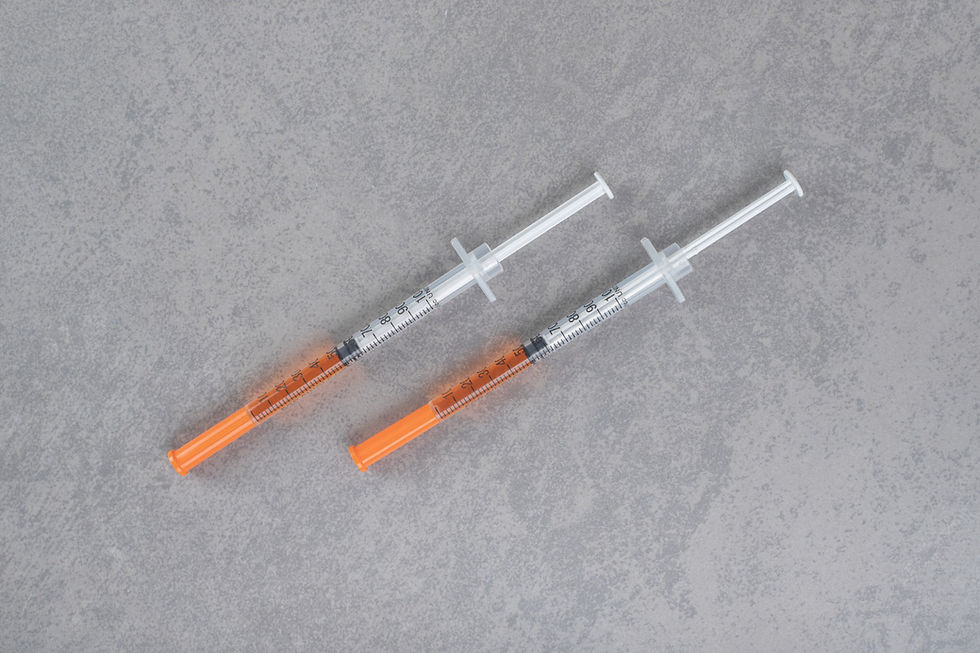
Pharmaceutical sharps waste occurs when needles, syringes, lancets, and other sharp devices are used in drug administration. While sharps management falls under OSHA's Bloodborne Pathogens Standard as an occupational safety issue, the pharmaceutical residue in a used syringe also makes it pharmaceutical waste.
When a syringe has been used to administer a RCRA-listed hazardous pharmaceutical, the syringe itself must be managed as hazardous pharmaceutical waste in addition to following sharps disposal protocols. Mixing pharmaceutical sharps with general sharps without considering the hazardous classification of the drug administered is a documented compliance failure in healthcare settings.
How to Dispose of Pharmaceutical Sharps Waste: Used sharps must always go directly into an approved sharps container immediately after use. If the pharmaceutical administered was RCRA hazardous, the sharps container and its contents must enter the hazardous pharmaceutical waste stream. Non-hazardous pharmaceutical sharps follow standard medical waste disposal pathways. In household settings, patients using injectable medications such as insulin should use a sharps container and dispose of it through a community take-back program, drop-off site, or mail-back program.
6. Over-the-Counter and Household Medication Waste
The pharmaceutical waste generated in American homes is enormous in aggregate and largely unregulated at the household level. Expired ibuprofen, half-used antibiotic courses, leftover cough syrups, outdated vitamins, and unused patches all represent household pharmaceutical waste that most people have no idea how to handle.
The most common disposal mistake individuals make is flushing medications down the toilet or washing them down the sink. Research has consistently linked improper medication disposal practices to the presence of pharmaceutical compounds in the water supply. While the FDA notes that flushing contributes only minimally to overall water contamination compared to normal human excretion, the agency still maintains a specific flush list for medications whose risk of accidental exposure or diversion outweighs environmental concerns, primarily high-potency opioids and certain other controlled substances.
How to Dispose of Household Medication Waste: The best option for most medications is a DEA-authorized take-back kiosk or a National Take Back Day event. For medications not accepted at take-back locations, the FDA's recommended at-home method is to mix the medication with an unpalatable substance such as used coffee grounds or dirt, seal it in a container, and place it in household trash with any personal information removed from the label.
Color Coding for Pharmaceutical Waste Containers
Healthcare facilities use a standardized container color system to ensure proper segregation:
Black containers are for RCRA hazardous pharmaceutical waste, including P-listed and U-listed drugs.
Purple containers are for trace chemotherapy waste and non-RCRA antineoplastic waste.
Blue or white containers are typically used for non-hazardous pharmaceutical waste.
Red containers are for regulated medical waste (biohazardous materials), not pharmaceutical waste.
Mixing pharmaceutical waste categories in the wrong container is one of the most cited compliance failures in healthcare waste audits and can result in significant regulatory penalties.
Regulatory Framework: Who Governs What
Pharmaceutical waste in the United States sits at the intersection of multiple regulatory bodies.
The EPA governs hazardous pharmaceutical waste under RCRA. The EPA's 2019 Hazardous Waste Pharmaceuticals Rule, updated with technical corrections in February 2025, established tailored management standards specifically for healthcare facilities and reverse distributors.
The DEA governs controlled substance disposal under the Controlled Substances Act, including requirements for documentation, authorized collection, and witnessed destruction.
The FDA provides guidance on consumer medication disposal and maintains the flush list for specific high-risk medications.
State environmental agencies add a layer of jurisdiction that in many cases is stricter than federal requirements. RCRA violations can carry penalties up to $76,000 per day. DEA violations for controlled substance mismanagement can reach $15,000 per incident. Facilities that do not maintain current knowledge of both federal and state requirements face compounding exposure.
Quick Answers
Q1: What is the difference between hazardous and non-hazardous pharmaceutical waste?
Hazardous pharmaceutical waste is any pharmaceutical that either appears on the EPA's RCRA P-list or U-list, or that exhibits one of four hazardous characteristics: ignitability, corrosivity, reactivity, or toxicity. Non-hazardous pharmaceutical waste covers all medications that do not meet those criteria. While non-hazardous waste is less strictly regulated at the federal level, it still requires proper disposal through licensed channels in most healthcare settings and cannot simply be placed in regular trash or flushed without considering applicable state and facility-level regulations.
Q2: Can I flush unused medications down the toilet?
In most cases, no. The FDA recommends against flushing medications as a routine disposal method because pharmaceutical compounds have been detected in U.S. waterways and drinking water sources, linked in part to improper disposal. The FDA does maintain a specific flush list of high-risk medications, primarily strong opioids and other controlled substances, for which the risk of accidental exposure or diversion is considered to outweigh environmental concerns. For all other medications, the preferred disposal method is a DEA-authorized take-back program or the FDA's recommended at-home method of mixing with an undesirable substance and placing in sealed trash.
Q3: How must healthcare facilities dispose of controlled substances?
Healthcare facilities must follow DEA requirements for controlled substance disposal. Schedule II substances require DEA Form 222 for transfer to a DEA-registered reverse distributor and DEA Form 41 as the destruction record. Schedules III through V require detailed records of transfer and destruction, though Form 222 is not required. Facilities may also destroy controlled substances on-site using a DEA-authorized destruction device, provided the destruction is witnessed as required by DEA regulations. Under no circumstances can controlled substances be disposed of in regular trash, general pharmaceutical waste containers, or the sanitary sewer without proper documentation and authorization.
Q4: What are the penalties for improper pharmaceutical waste disposal?
The penalties for improper pharmaceutical waste disposal depend on the regulatory body involved and the nature of the violation. RCRA violations enforced by the EPA can carry civil penalties up to $76,000 per day per violation. DEA violations for improper controlled substance management can reach $15,000 per incident. In addition to federal penalties, state environmental agencies may impose their own fines. Beyond direct financial penalties, facilities that generate media coverage from a pharmaceutical waste compliance failure face reputational damage, increased regulatory scrutiny, and potential civil liability.
Q5: What is trace chemotherapy waste and how is it different from bulk chemotherapy waste?
Trace chemotherapy waste consists of items that have been contaminated with antineoplastic drugs but contain less than 3 percent of the original drug quantity. Examples include empty IV bags, used gloves and gowns, tubing, and gauze used during chemotherapy administration. Bulk chemotherapy waste consists of items that contain more than 3 percent of the original drug, such as partially used vials, syringes with residual drug, and IV bags that are still partially full. Trace chemo waste goes into purple containers and is managed through high-temperature incineration. Bulk chemo waste is typically classified as RCRA hazardous and must enter the black container hazardous waste stream.
Q6: What pharmaceutical waste disposal options are available to individuals at home?
Individuals have several options for safe household pharmaceutical waste disposal. The most recommended option is a DEA-authorized medication take-back kiosk, available at many retail pharmacies, hospitals, and law enforcement offices. The DEA also holds National Prescription Drug Take Back Day events twice yearly. Mail-back programs are available from some pharmacies and healthcare programs, allowing patients to send sealed envelopes of unused medications to licensed incineration facilities through the U.S. Postal Service. For medications not accepted at take-back locations, the FDA's recommended at-home method is to mix them with an undesirable substance such as used coffee grounds or dirt, seal the mixture in a container, remove personal information from the original packaging, and place it in household trash.


Comments