
Secure Document Destruction: The Missing Link in Responsible Recycling

Key Takeaway
Secure document destruction is the essential process of shredding confidential paper and crushing electronic media before they enter the recycling stream. This preventive step ensures that sensitive corporate and personal data is rendered permanently unrecoverable, helping businesses remain compliant with privacy regulations such as HIPAA and FACTA. By securely shredding materials first, organizations can safely return up to 95% of paper pulp to the circular economy without risking a catastrophic data breach.
Picture this: a business finishes its quarterly audit, boxes up years of financial statements, employee records, and client contracts, and drops them into the nearest recycling bin. The intent is admirable. The outcome could be catastrophic.
Recycling paper is one of the simplest ways a business or individual can reduce their environmental footprint. But recycling a document and destroying it are not the same thing. When confidential information is placed in a standard recycling stream without being shredded first, it does not disappear into pulp and good intentions. It passes through hands, facilities, and processes that offer no guarantee of privacy, leaving sensitive data exposed at every point in the journey.
This is the blind spot at the center of most recycling conversations: security and sustainability are not competing goals, but they require deliberate alignment. Secure document destruction is the bridge between the two, and understanding how it works, why it matters, and what it means for businesses and individuals has never been more urgent.
Why Is Secure Document Destruction a Pressing Legal and Financial Requirement?

The numbers surrounding data loss from improperly discarded documents are striking. A study by Javelin Strategy & Research found that 17 percent of identity theft cases involved information obtained through dumpster diving. That is not a relic of a pre-digital era. Physical documents remain one of the most reliable entry points for criminals targeting personal and corporate data, precisely because people assume that tossing something in a bin makes it inaccessible.
The broader picture is more alarming still:
Rising Breach Costs: According to IBM's Cost of a Data Breach Report 2025, the average cost of a data breach for U.S. businesses reached a record $10.2 million, a 9 percent increase over 2023.
Massive Fraud Losses: The FTC reported that consumers lost more than $12.5 billion to fraud in 2024, a 25 percent jump from the year before.
Physical Records At Fault: While cyberattacks drive a large share of these figures, improperly disposed of physical records remain a meaningful and preventable contributor.
Document security is also a strict legal obligation. In the United States, regulations including HIPAA, the Fair and Accurate Credit Transactions Act (FACTA), the Gramm-Leach-Bliley Act, and various state-level privacy laws require businesses to securely dispose of records containing personal and financial information. Failure to comply carries penalties that can reach into the millions. Organizations that treat document destruction as optional are not just careless—they are legally exposed.
What Does Secure Document Destruction Actually Mean?
Secure document destruction is the process of rendering confidential information permanently unreadable and unrecoverable before the physical material enters the recycling or waste stream.
For paper documents: This almost always means professional shredding.
For digital storage media: For hard drives, USB drives, and solid-state drives (SSDs), it means either certified data wiping followed by physical destruction or outright shredding of the device itself.
The keyword is "before." Secure destruction is not something that happens downstream in a recycling facility. It is a deliberate step that occurs before any material changes hands, ensuring that no readable information can be intercepted, reconstructed, or sold at any point in the process.
For businesses, this means working with a certified destruction provider rather than relying solely on office shredders. On-site office shredders, while useful for daily disposal, typically produce strip or cross-cuts that may not meet the security standards required by law or by industry certification bodies.
What Is NAID AAA Certification and Why Does It Matter?
In the document destruction industry, NAID AAA certification from the International Secure Information Governance and Management Association (i-SIGMA) is the recognized gold standard. Providers carrying this certification undergo both scheduled and unannounced audits conducted by accredited security professionals.
These comprehensive audits evaluate every stage of the destruction process:
Employee background checks and rigorous vetting
Strict chain-of-custody and transport protocols
Secure facility access controls
The final particle size of the shredded material
For businesses selecting a document destruction partner, NAID AAA certification is evidence that the provider has undergone independent scrutiny and can demonstrate compliance with applicable data protection laws. When a breach occurs and regulators ask for documentation of destruction practices, NAID-certified providers issue a Certificate of Destruction that serves as verifiable proof of secure disposal. Businesses that burn documents rather than shred them often cannot obtain this certificate, creating a costly compliance gap when auditors arrive.
Does Shredding Paper Hurt or Help Recycling?
Professional document shredding actively protects the environment while preserving security. Shredded paper does not end up in a landfill; it enters the recycling supply chain in a form that protects both information and the planet.
After shredding, paper particles are baled and transferred to certified recycling partners, where they are processed into pulp and repurposed for new paper products.
The destruction process does not remove the material from the circular economy; it sanitizes it before re-entry. Shredding protects information while enabling responsible recycling. Simply placing an intact document in a recycling bin, by contrast, creates a severe security risk under the illusion of environmental responsibility.
How Should Businesses Destroy Old Hard Drives and Electronics?
The same principles that apply to paper documents also apply to the electronic devices that businesses retire regularly. Hard drives, laptops, smartphones, servers, and USB drives all hold data that standard deletion or basic formatting does not erase.
Research consistently shows that the majority of discarded devices contain residual data from previous owners. A study from the ICO found that standard formatting only removes the file allocation table; the underlying data remains easily recoverable using freely available software tools.
This creates a serious compliance risk for any business that donates, resells, or recycles electronic equipment without certified data destruction. For organizations operating under GDPR, HIPAA, or state-level privacy laws, passing old devices to a recycler or charity without documented data destruction can constitute a reportable data breach, regardless of intent.
The Scale of the Data Destruction Market
The data destruction services market reflects the massive scale of this problem. Valued at $12 billion, the market is projected to grow to $39.3 billion, expanding at a compound annual growth rate (CAGR) of 12.6 percent. North America accounts for approximately 38 percent of market share, driven by stringent regulatory requirements under HIPAA, CCPA, and related legislation.
Certified IT asset disposal (ITAD) providers handle electronic media destruction in a way that mirrors the paper model: data is securely destroyed first, then the physical components are separated and routed to certified recycling partners for responsible recovery of precious metals and materials.
How Do You Build a Secure Document Destruction Program?
For businesses implementing or upgrading their document destruction practices, a few foundational principles apply regardless of company size or industry:
Start with a Clean Desk Policy: Documents should not accumulate on desks or in unlocked filing cabinets where they can be accessed by unauthorized individuals. Confidential papers should move directly from use to a secure collection console.
Use Secure Collection Consoles, Not Recycling Bins: NAID-certified shredding services typically provide locked consoles that accept documents but do not allow retrieval. Employees drop documents in; no one can pull them out. This is a critical distinction from standard office recycling bins, where any person walking by can read discarded documents.
Establish a Routine Destruction Schedule: Depending on the volume of sensitive documents a business generates, scheduled shredding services on a weekly, monthly, or on-demand basis can ensure that document accumulation never creates a security backlog. Providers should issue a Certificate of Destruction after each collection to maintain an auditable paper trail.
Apply the Same Standards to Digital Media: Any electronic device leaving the organization should be documented, wiped, or physically destroyed by a certified provider. This process must be accompanied by a destruction certificate that includes serial numbers, the method used, and the date of destruction.
Why Does This Matter Beyond Regulatory Compliance?
Secure document destruction is ultimately about trust. Patients trust hospitals to protect their medical records. Clients trust financial advisors with their account details. Employees trust employers with their personal information. When any of that trust is broken through careless disposal, the damage extends far beyond regulatory fines.
For businesses that have made public sustainability commitments, the connection between secure destruction and responsible recycling is also a matter of credibility. Recycling paper without shredding it is a dangerous shortcut that poses risks without delivering the true circular-economy benefits of genuine recycling. Secure document destruction completes the loop: it protects people and safely returns materials to productive use. Security and sustainability do not have to pull in opposite directions. When handled with the right process and the right partner, they reinforce each other at every step.
Frequently Asked Questions (FAQs)
Q1: What is the difference between document recycling and secure document destruction?
Secure document destruction shreds or destroys documents before they enter the recycling stream, making information permanently unrecoverable, whereas standard recycling does not. When paper is placed in a general recycling bin without being shredded first, readable information remains fully exposed and can be intercepted at any point in the collection and processing chain. Most privacy laws require secure destruction—not just recycling—for records containing personal or financial data.
Q2: What types of documents require secure destruction?
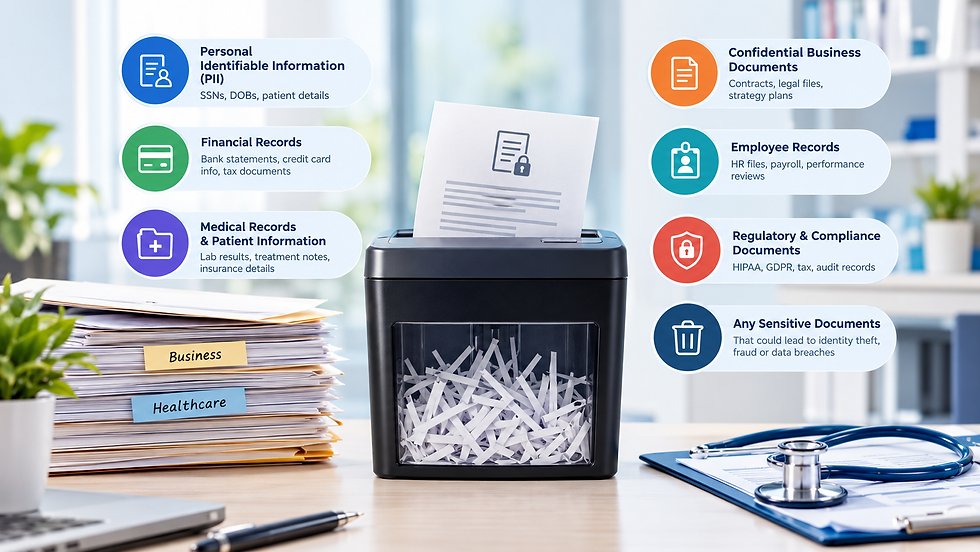
Any document containing personally identifiable information (PII), financial data, medical records, legal records, or proprietary business information must be securely destroyed. This includes bank statements, tax returns, contracts, insurance documents, payroll records, client files, and prescription records. A good rule of thumb for organizations and individuals alike is: when in doubt, shred it.
Q3: What is NAID AAA certification, and why does it matter when choosing a shredding provider?
NAID AAA certification is an independent security credential issued by i-SIGMA that verifies that a document destruction provider meets rigorous data protection standards. Certified providers must pass unannounced audits evaluating employee background checks, strict chain-of-custody tracking, and particle size. Choosing an NAID AAA provider ensures compliance with laws like HIPAA and provides you with a legally verifiable Certificate of Destruction.
Q4: Is shredded paper actually recycled, or does it just go to a landfill?
Yes, properly shredded paper from a certified destruction provider goes directly into the recycling supply chain to be manufactured into new products. Once shredded and baled, the paper is sent to paper mills for processing into pulp. Industry data show that up to 95 percent of professionally shredded paper is successfully recovered and repurposed into everyday items such as tissue paper and packaging.
Q5: How should businesses dispose of old hard drives and electronic storage devices securely?
Businesses must use a certified IT asset disposal (ITAD) provider to physically crush, shred, or overwrite electronic media using certified data-wiping software. Standard deletion or drive formatting is completely insufficient, as the underlying data remains fully recoverable with basic software. Solid-state drives (SSDs) cannot be reliably wiped via software and require physical shredding to guarantee data destruction.
Q6: Are individuals legally required to shred personal documents, or is this just a best practice?
Individuals are not legally mandated by federal law to shred personal documents, though it is a highly recommended best practice to prevent identity theft. In contrast, businesses are strictly bound by laws like FACTA to securely dispose of consumer data. Because roughly 17 percent of identity theft cases stem from physical document theft and dumpster diving, individuals should always shred bank statements, utility bills, and medical mail before discarding them.


Comments